Comparing Perfume Quotes: Where a Price Sheet Hides Its Real Cost
A perfume quote is a bundle of services wearing a single number, which is why three suppliers can answer the same brief with totals that look unrelated. The fragrance compound is only one line; tooling, decoration, testing, freight and minimum order rules account for much of the rest. Comparing quotes line by line, and asking the same questions of every supplier, turns a guess into a decision you can defend.
Key takeaways
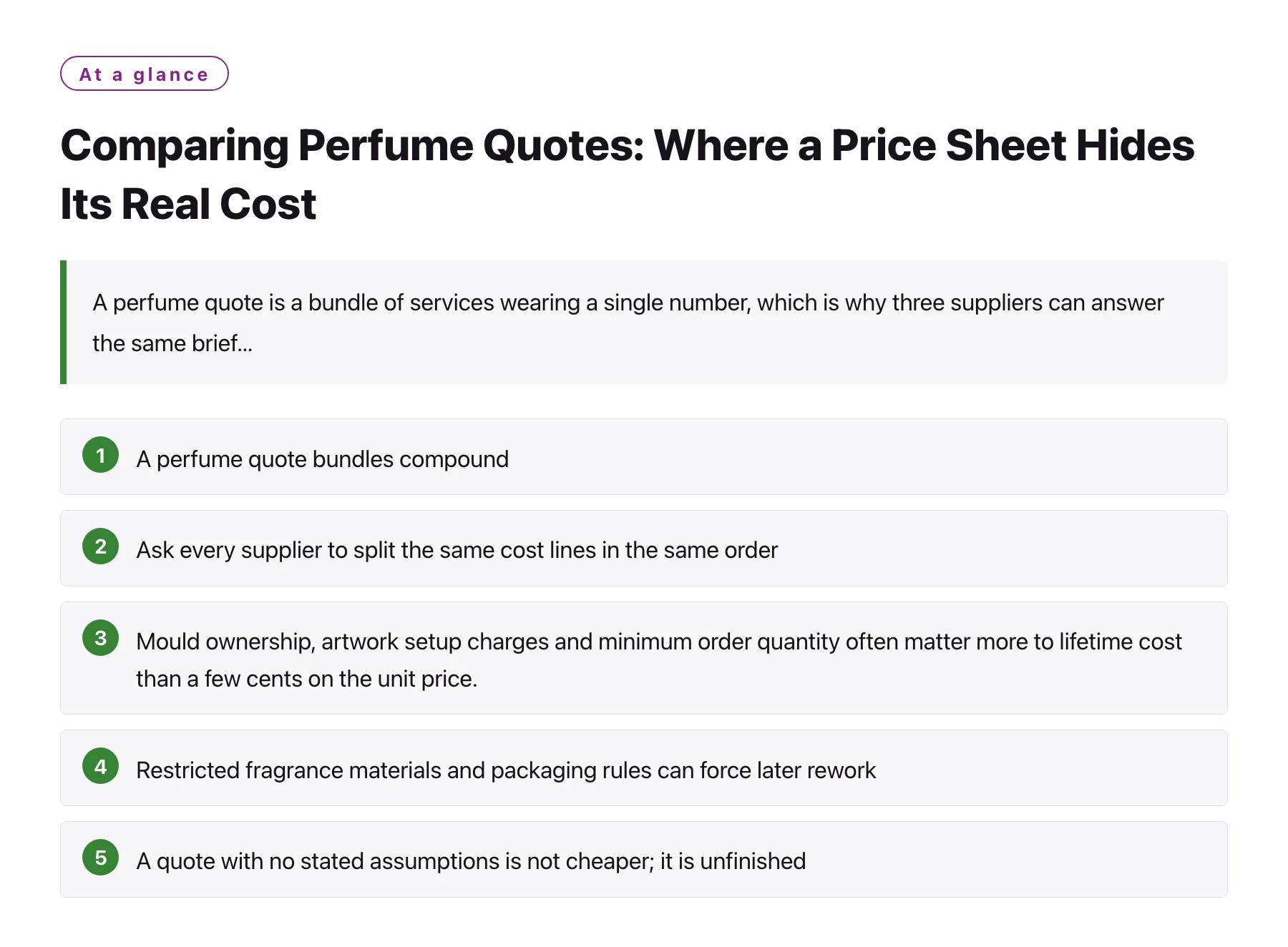
- A perfume quote bundles compound, packaging, tooling, testing and freight, so one unit price cannot be compared directly against another unit price.
- Ask every supplier to split the same cost lines in the same order, then compare line against line rather than total against total.
- Mould ownership, artwork setup charges and minimum order quantity often matter more to lifetime cost than a few cents on the unit price.
- Restricted fragrance materials and packaging rules can force later rework, so the compliance scope belongs inside the quote comparison.
- A quote with no stated assumptions is not cheaper; it is unfinished, and the missing lines reappear on a later invoice.
Most brand owners open the conversation by asking for a price per unit. It is a reasonable question, but it invites an answer that is technically true and practically useless, because each supplier decides for itself what that unit price includes.
The comparison becomes manageable once you treat a quote as a list of decisions rather than a single figure. This guide covers the lines that move the total, the questions that expose hidden assumptions, and the moments when a low-looking quote turns into the expensive one.
Why two quotes for the same brief diverge
Strip away the formatting and every fragrance quote contains the same categories: compound, container, closure, decoration, filling, testing, packing and freight. Suppliers differ in how much of that bundle they price, and in what order quantity they assume while pricing it.
That is the whole explanation for most of the gap. One supplier quotes at a large quantity and folds tooling into the unit price; another prices a small first run and lists tooling separately. Neither is dishonest, but the totals cannot be read side by side until the assumptions behind them match.
The compound is priced against a brief, not a bottle
Fragrance compound is usually the most expensive single input, so the largest cost lever is not the supplier's margin but the brief itself: how complex the formula is, whether it leans on costly naturals, and how much material is needed to reach the intended effect.
There is a regulatory dimension as well. The International Fragrance Association maintains standards that restrict how much of certain materials may be used, and in which product types [1]. If a brief depends heavily on a restricted material, the formula may have to be adjusted later, and the cost of that adjustment belongs inside your comparison rather than in a surprise invoice.
Packaging and freight move more than buyers expect
Bottle, cap, pump and decoration are frequently the second-largest cost block, and they are the block most likely to be quoted loosely. Glass weight, mould ownership, the number of print passes and whether a decoration setup is charged once or per order all change the number.
Packaging rules add a second layer. European measures on packaging and packaging waste are pushing brands toward designs that are easier to recycle and refill [3], and trade coverage of the personal care supply chain keeps pointing to packaging and freight as the most volatile lines in a landed cost [2]. A supplier who prices a pack that will not meet a target market's rules has not offered a saving; it has offered a redesign later.
Tooling, artwork and minimum quantities
Moulds, print plates and label dies are one-time costs, but who owns them decides what happens at reorder. If the supplier owns the tooling, moving production later often means paying for the same tool twice.
Minimum order quantities work the same way. A low minimum looks friendly on a first order and can raise the unit price sharply, so an honest comparison includes the quantity at which the unit price settles.
The lines that decide the landed unit cost
| Cost line | How it is often quoted | What actually drives it | Question worth asking |
|---|---|---|---|
| Fragrance compound | One blended figure per kilogram | Material choices, restricted-material headroom, order size | Which materials carry restrictions, and how much headroom is left? |
| Bottle and closure | Folded into the unit price | Mould ownership, order quantity, decoration method | Do we own the mould, and what does a reorder cost? |
| Decoration | Per unit or per production run | Print plates, label setup, number of colour passes | Is the setup charged once, or every time we order? |
| Testing and documentation | Fixed fee, sometimes omitted | Scope of testing, markets served, depth of documentation | Which markets does the report cover, and who holds it? |
| Freight and delivery terms | Quoted separately, or not at all | Incoterms, fill weight, pallet configuration | Which Incoterm applies, and who pays duty? |
Notice how many of these lines are governed by assumptions rather than by material quality. A supplier who shows the assumptions is easier to compare and easier to hold to the number later; a supplier who hides them is not cheaper, only less specific.
Normalising four quotes before you negotiate
- Send one written brief to every supplierSame category, same target market, same fragrance direction, same pack. If the inputs differ, the outputs cannot be compared.
- Fix quantity and delivery terms firstName the first-order quantity and the Incoterm you want, because both move the unit price more than most buyers anticipate.
- Request the split, not the totalAsk for compound, container, closure, decoration, filling, testing and freight as separate lines, in that order, so the answers line up.
- Ask what happens at reorderConfirm tooling ownership, the reorder quantity and whether setup charges return. Lifetime cost is decided in this conversation.
- Pin down testing and documentationScope, markets covered, and who holds the report. Documentation that has to be commissioned twice is a hidden second cost.
- Price one realistic changeAsk what a different closure or an extra label round would cost, so you know how the number behaves when the brief moves.
A quote that sits noticeably lower than the rest is not automatically wrong, but it always deserves an explanation. In practice the gap comes from one of four places: a larger assumed order quantity, tooling that stays with the supplier, testing and documentation left out of scope, or terms that put freight and duty on you. Ask which one applies, and write the answer next to the quote. A supplier who can name the difference usually knows the cost structure, which is a better signal than any single figure. Recording it also means the comparison survives the next round of emails.
From comparison to decision
At the end of the exercise you should be able to explain, in one paragraph, why the quote you chose is the one you chose. If the explanation is that it was lower, the work is not finished.
Score the structure, not only the price
Write down four notes per supplier: how completely they split the cost, how clear they were on tooling and reorder terms, how far their testing and documentation scope reaches, and how quickly they answered a follow-up question. Suppliers who read well on all four are usually the ones whose invoices match their quotes.
Where the money quietly goes
A useful exercise is to rebuild the quote yourself, line by line, and see whether the total still holds together. For a concrete walkthrough of the places a price sheet can lose money, see where a perfume quote can hide costs.
Buyers who do this once rarely go back to comparing totals. Manufacturers that run their own filling and packaging operations, such as Xuelei in Guangzhou, can quote more of the bundle inside a single scope, which makes the split easier to read and easier to challenge.
Sources
- IFRA Standards Library (International Fragrance Association) —— The IFRA Standards Library lists the restrictions the fragrance industry applies to individual fragrance ingredients, based on safety assessments; it is the reference point for compliant fragrance formulation.
- HAPPI — Household & Personal Products Industry —— An industry magazine covering the household and personal care market, including fragrance, formulation and packaging.
- European Commission: Packaging Waste and the PPWR —— EU rules on packaging and packaging waste, including the Packaging and Packaging Waste Regulation requirements on recyclability and design.
Frequently asked questions
Why is one perfume quote so much lower than the others?
Usually because it assumes something different rather than because it is more efficient. Common causes are a larger order quantity, tooling that remains the supplier's property, testing and documentation left outside the scope, or delivery terms that shift freight and duty to you. Ask which assumption explains the gap.
Should I compare perfume quotes per unit or as a total?
Compare both, but only after splitting each quote into the same lines. The unit price tells you what a reorder will feel like, while the total for the first order tells you what leaving your bank account now. Neither number means much if the quantity and Incoterm differ between suppliers.
Who should own the bottle mould?
If the design is distinctive and you plan to reorder, owning the mould keeps your options open. If you are using a stock bottle, ownership matters far less. Either way, confirm in writing who holds the tool, what a reorder costs, and what happens to the mould if you move production.
Does a higher fragrance oil percentage always cost more?
Generally yes, because the compound is the most expensive input per kilogram and it scales roughly with the load. The materials inside the compound matter just as much, so a modest load built on rare naturals can cost more than a heavier load built on common aroma chemicals.
What should be in writing before I pay a deposit?
The cost split you compared, the confirmed order quantity, tooling ownership, decoration setup rules, the testing and documentation scope, the delivery terms, and what a change after approval will cost. A deposit secures a specification, so the specification should be on paper first.