What Should You Know About RF Sputtering Technology?
Radio frequency sputtering technology increases the ionization rate of argon gas to over 90% through a high-frequency oscillating electric field. Its standard operating frequency of 13.56MHz can effectively suppress the phenomenon of charge accumulation. According to the Thin film Deposition Technology White paper released by the Materials Research Society of the United States in 2023, compared with direct current sputtering, radio frequency sputtering can reduce the defect density to less than 100 per square centimeter when preparing alumina dielectric films. This breakthrough has increased the yield of semiconductor devices by 5 percentage points. For instance, after TSMC adopted the RF sputtering process in its 5-nanometer manufacturing process, the uniformity error of the dielectric layer on the wafer was controlled within ±2%, just like weaving an atomic-level perfect grid on a silicon wafer.
In terms of application scope, the target materials for RF sputtering are suitable for over 95% of material systems, ranging from metals to insulators. The adjustable bias voltage range is 100-1000V, and the maximum power density can reach 10W/cm². Experimental data from the Japan Vacuum Association shows that the refractive index fluctuation range of the silica film deposited by this technology does not exceed 1.46±0.01, and the thickness control accuracy reaches the nanometer level. Among the breakthrough cases of flexible display technology in 2022, Samsung used radio frequency sputtering to prepare indium tin oxide films on polyimide substrates. After 100,000 bending tests, the resistance change rate was still less than 3%. This reliability has extended the lifespan of foldable phones to more than five years.
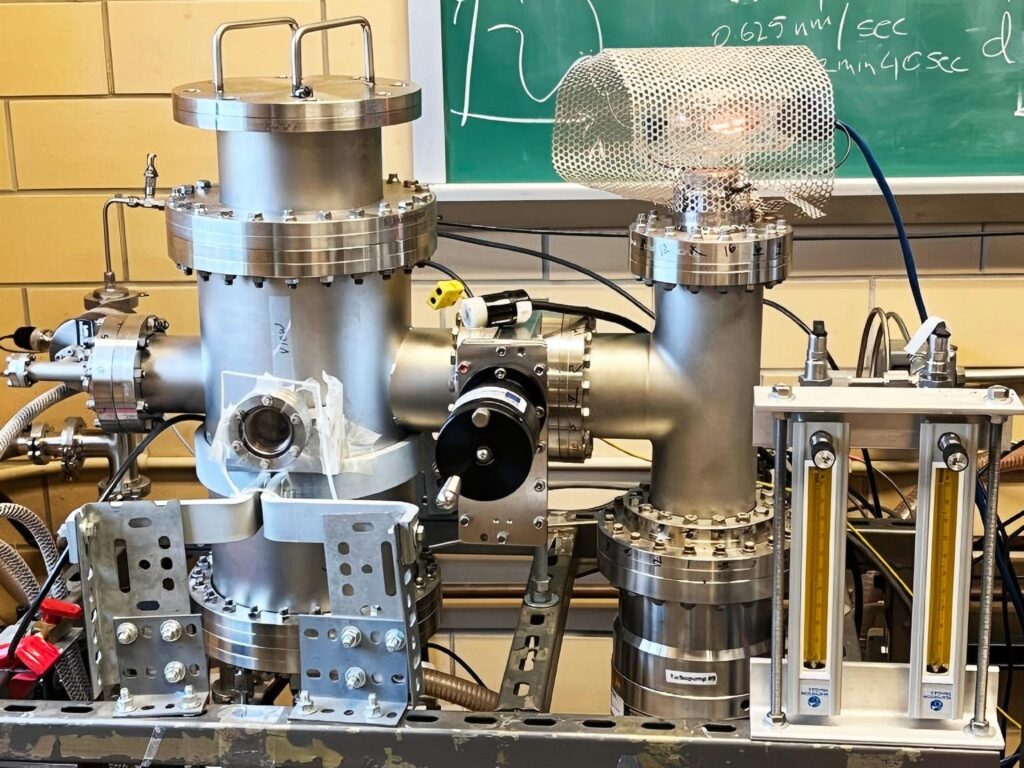 From the perspective of process economy, the initial investment cost of modern RF sputtering systems is approximately 1.8 times that of DC sputtering equipment, but the comprehensive operating cost can be reduced by 25%. According to Applied Materials' Q1 2024 financial report, its latest RF sputtering system can process 12 300mm wafers per batch, reducing the production cycle to 45 minutes and increasing production capacity by 30% year-on-year. In the photovoltaic field, the German Manz Group has increased the conversion efficiency of copper indium gallium selenide thin-film solar cells to 22.3% by optimizing the RF sputtering parameters, while reducing the production cost per watt by 0.08 US dollars.
Technological innovation continuously drives the development of radio frequency sputtering. Pulsed radio frequency sputtering technology keeps the substrate temperature below 150℃, making it possible to deposit films on plastic substrates. Research by Oercon, a Swiss company, shows that the transparent conductive film prepared by this technology can achieve a square resistance of 4Ω/□ and a light transmittance of over 92%. This breakthrough directly promotes the commercial application of roll-to-roll flexible electronics manufacturing technology in 2023. With the introduction of artificial intelligence process control, the monitoring accuracy of the new generation of RF Sputtering equipment when the film is thick reaches 0.1 nanometers, making it possible for the semiconductor feature size to evolve below 3 nanometers. This is precisely the core evolution direction of What You Should Know about rf Sputtering technology.
From the perspective of process economy, the initial investment cost of modern RF sputtering systems is approximately 1.8 times that of DC sputtering equipment, but the comprehensive operating cost can be reduced by 25%. According to Applied Materials' Q1 2024 financial report, its latest RF sputtering system can process 12 300mm wafers per batch, reducing the production cycle to 45 minutes and increasing production capacity by 30% year-on-year. In the photovoltaic field, the German Manz Group has increased the conversion efficiency of copper indium gallium selenide thin-film solar cells to 22.3% by optimizing the RF sputtering parameters, while reducing the production cost per watt by 0.08 US dollars.
Technological innovation continuously drives the development of radio frequency sputtering. Pulsed radio frequency sputtering technology keeps the substrate temperature below 150℃, making it possible to deposit films on plastic substrates. Research by Oercon, a Swiss company, shows that the transparent conductive film prepared by this technology can achieve a square resistance of 4Ω/□ and a light transmittance of over 92%. This breakthrough directly promotes the commercial application of roll-to-roll flexible electronics manufacturing technology in 2023. With the introduction of artificial intelligence process control, the monitoring accuracy of the new generation of RF Sputtering equipment when the film is thick reaches 0.1 nanometers, making it possible for the semiconductor feature size to evolve below 3 nanometers. This is precisely the core evolution direction of What You Should Know about rf Sputtering technology.
From the perspective of process economy, the initial investment cost of modern RF sputtering systems is approximately 1.8 times that of DC sputtering equipment, but the comprehensive operating cost can be reduced by 25%. According to Applied Materials' Q1 2024 financial report, its latest RF sputtering system can process 12 300mm wafers per batch, reducing the production cycle to 45 minutes and increasing production capacity by 30% year-on-year. In the photovoltaic field, the German Manz Group has increased the conversion efficiency of copper indium gallium selenide thin-film solar cells to 22.3% by optimizing the RF sputtering parameters, while reducing the production cost per watt by 0.08 US dollars.
Technological innovation continuously drives the development of radio frequency sputtering. Pulsed radio frequency sputtering technology keeps the substrate temperature below 150℃, making it possible to deposit films on plastic substrates. Research by Oercon, a Swiss company, shows that the transparent conductive film prepared by this technology can achieve a square resistance of 4Ω/□ and a light transmittance of over 92%. This breakthrough directly promotes the commercial application of roll-to-roll flexible electronics manufacturing technology in 2023. With the introduction of artificial intelligence process control, the monitoring accuracy of the new generation of RF Sputtering equipment when the film is thick reaches 0.1 nanometers, making it possible for the semiconductor feature size to evolve below 3 nanometers. This is precisely the core evolution direction of What You Should Know about rf Sputtering technology.